15th May
Our group had started to split up. Most of us got on the coach for the airport and Casablanca – some stayed behind to spend more time in Marrakech. Edgar and I headed for Casablanca to spend a night there before flying to Barcelona the next day.
Colourful Africa! We had visited Chefchaouen, the Blue City, with its blue alleyways and blue-washed buildings, Marrakech, the Red City, with the red colour of its city walls (as the sun sets, the colour deepens and the whole cityscape takes on a romantic rose-tinted hue all its own) and now were about to experience the White City.
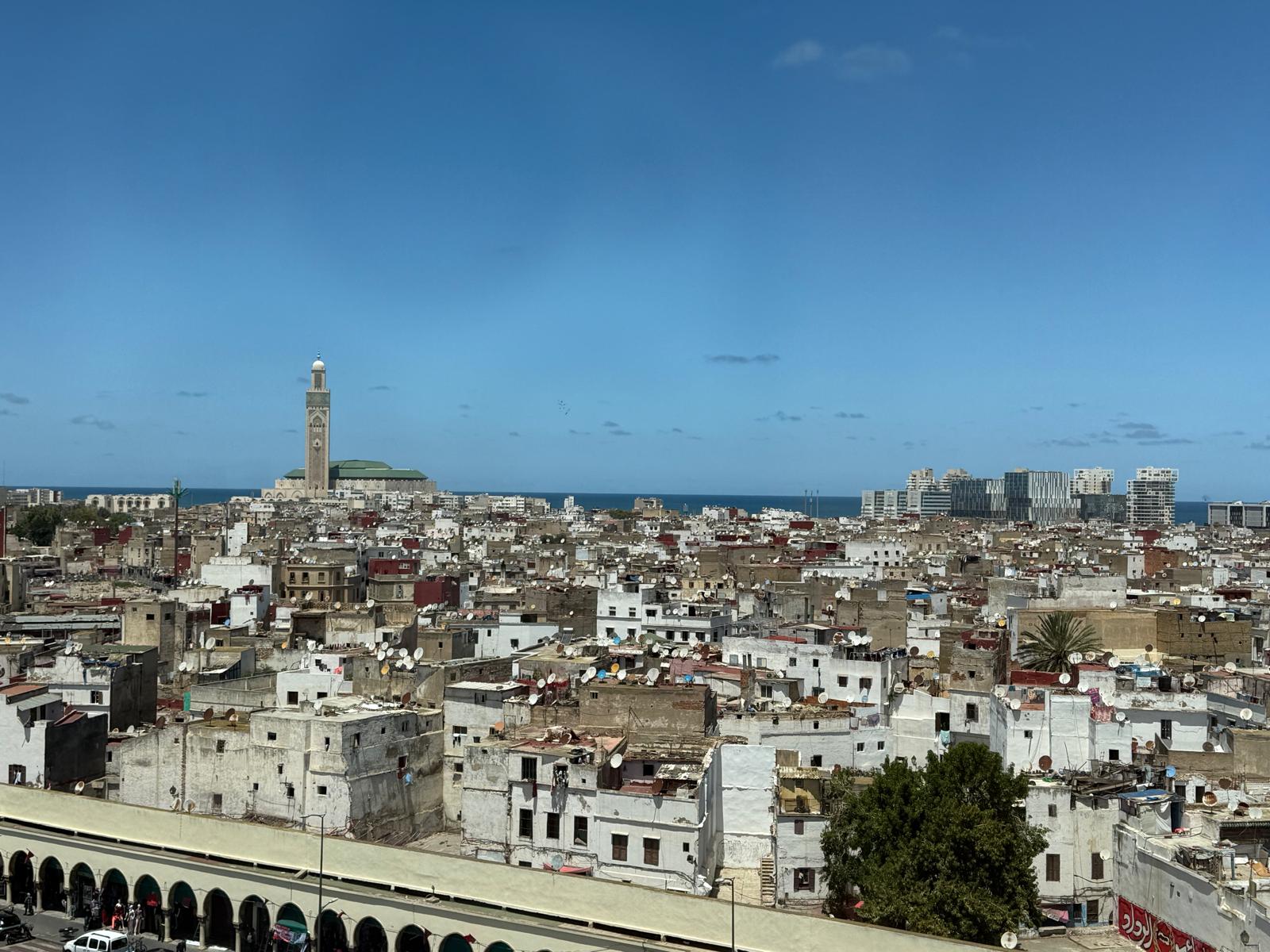
Casablanca is a cosmopolitan city that has become a go-to destination for business and leisure tourism and is a fascinating blend of European elegance and authentic Moroccan charm. The city center is impressive with a sweep of white coloured tall buildings along broad boulevards. The city is constantly evolving, with new infrastructure and improvements happening all the time – yet it never loses sight of its Moroccan soul.
We checked into our hotel, met up with our guide and set off to explore.
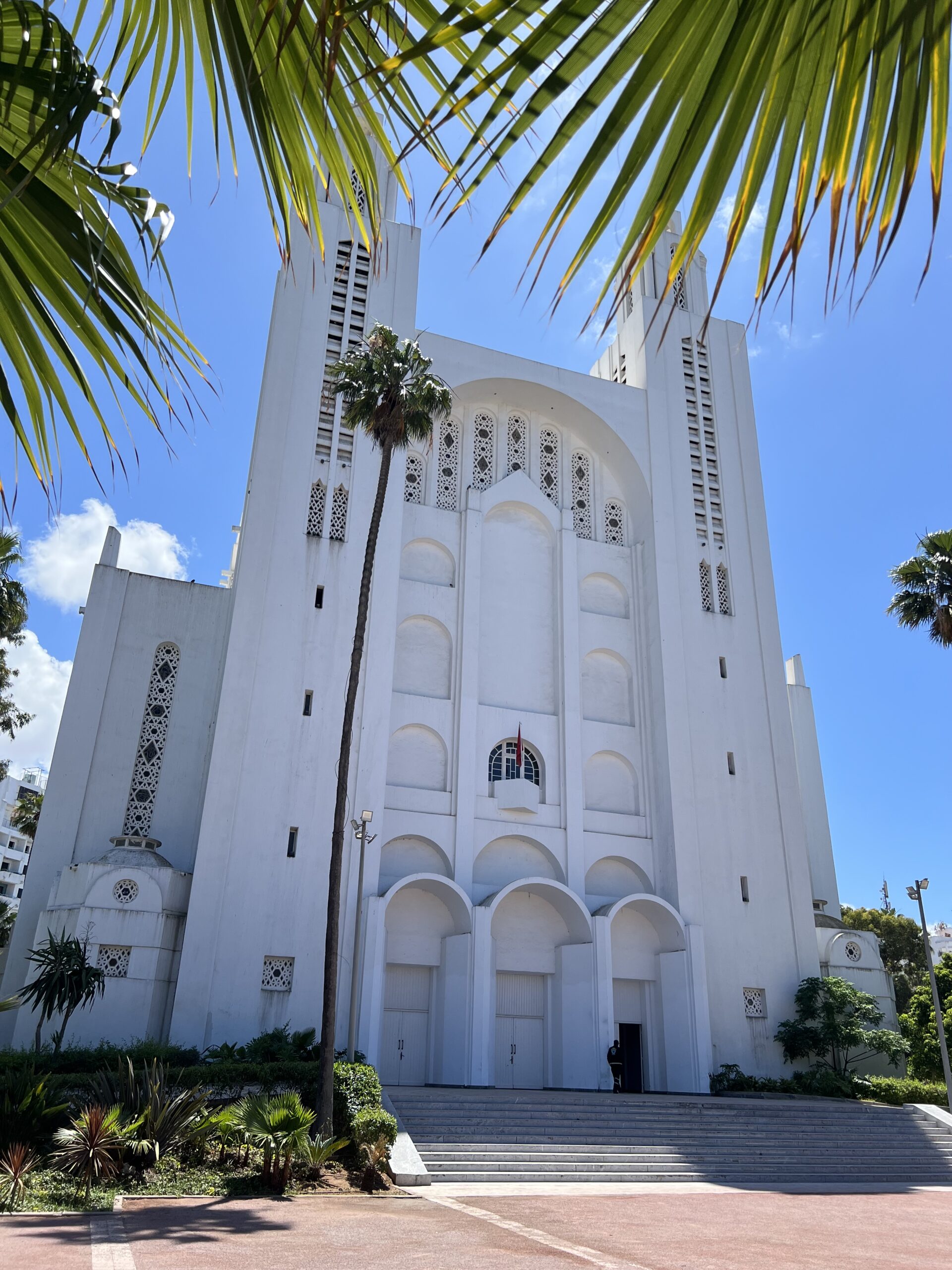
Our first stop was the Sacred Heart Church. Built in 1930, the church was designed in the Art Deco style and is the largest church in Morocco. It is commonly referred to as a cathedral, although it has never technically been one as it was never the seat of a Bishop. The Cathedral ceased its religious function in 1956, after the independence of Morocco and became a cultural centre which is open to visitors of all faiths.
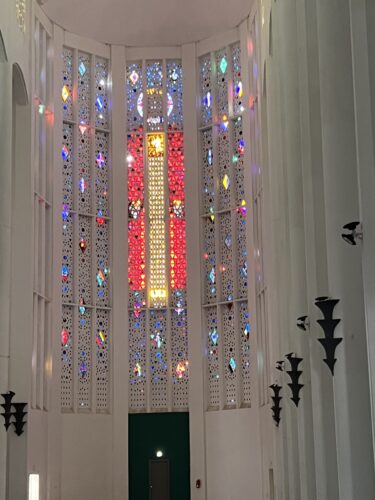
The beautiful coloured glass windows display flags from around the world – Danish, Swedish, Icelandic, Brazilian, and Norwegian – a good example of how Morocco embraces its international connections while honouring its heritage.
From the church, we went to Mohammed V Square, a public square of historical and symbolic significance located in central Casablanca. The square is a tribute to Morocco’s rich history and heritage and is flanked by a collection of buildings that mix Art Deco elements with Hispano-Muslim, Andalusian, and neo-Moorish influences, and which now house some of the city’s most important institutions. The statue of King Mohammed V, situated at the center of the square is there to symbolises national unity, resilience and progress.
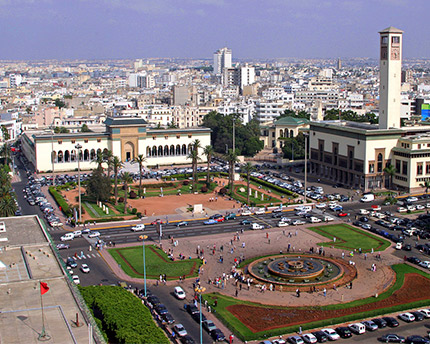
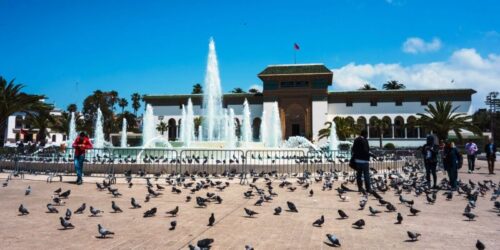
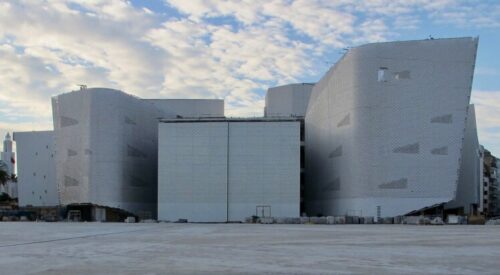
The large circular fountain in front of the Palace of Justice, in the centre of the square, is another of its distinctive features and occasionally provides a wonderful show with jets of water and music – unfortunately not whilst we were there. At the western end of the square the modern Grand Theatre of Casablanca has already become the area’s new icon. Winner of the Pritzker Architecture Prize in 1994, the building is made up of several pavilions reminiscent of an ancient medina.
There is no question that the No.1 attraction in Casablanca is the Hassan II Mosque which we were heading to next. Towering over the ocean, this magnificent structure is easily seen from miles away. Commissioned by King Hassan II in 1980 and completed in 1993, the mosque was to emulate Moroccan culture and identity.
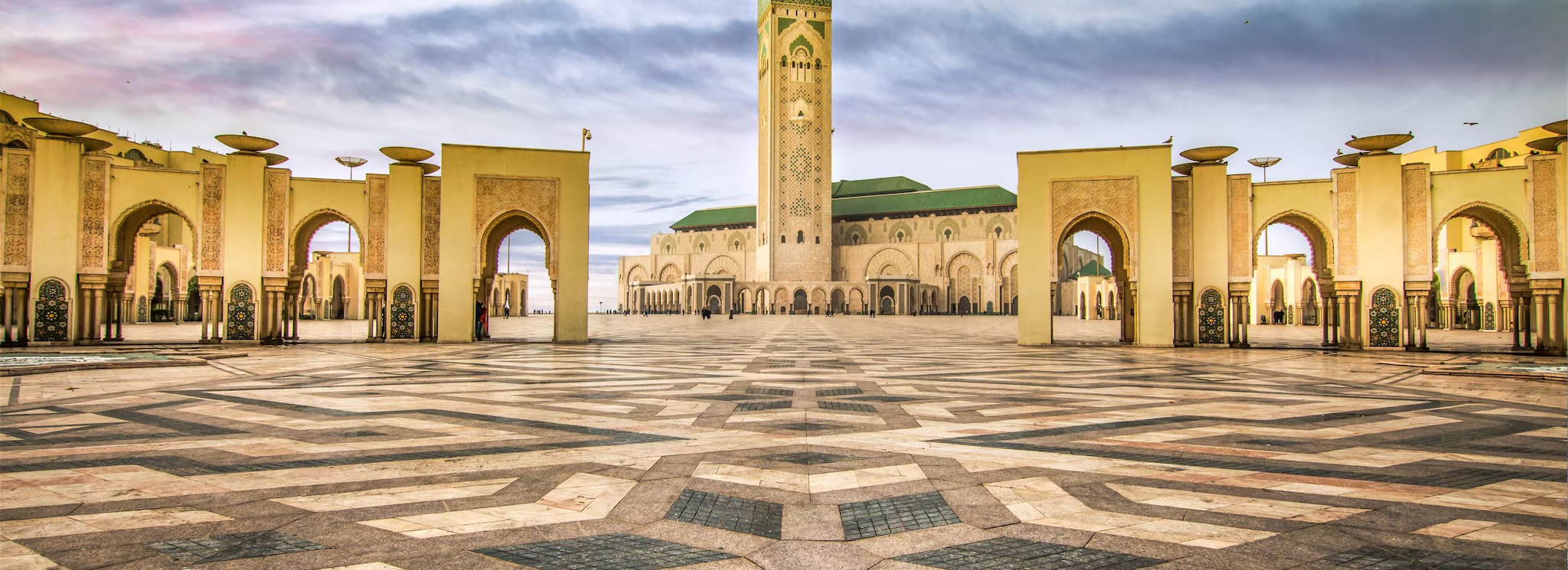
A massive achievement and structure, the courtyard surrounding the mosque has the capacity to hold 80,000 people and the mosque itself can accommodate up to 25,000 people. Next to the mosque, rising into the sky, the minaret is the world’s tallest at 210 meters. During the night, laser beams shoot towards Mecca to aid worshippers with the city’s correct direction.
The mosque can open its roof so you can look directly up at the sky, and in some places, you can actually look down and see the ocean below. Inspired by a quote in the Quran stating, “His was over the water” roughly half the mosque is built over the Atlantic Ocean. Hassan II explained that he wanted to build this mosque on the water, because God’s throne is on the water. Therefore, the faithful who go there to pray, to praise the creator on firm soil, can contemplate God’s sky and ocean”. This dual relationship between water and land is truly evident in some areas of the mosque that have glass floors allowing worshippers to pray directly over and look upon the ocean.
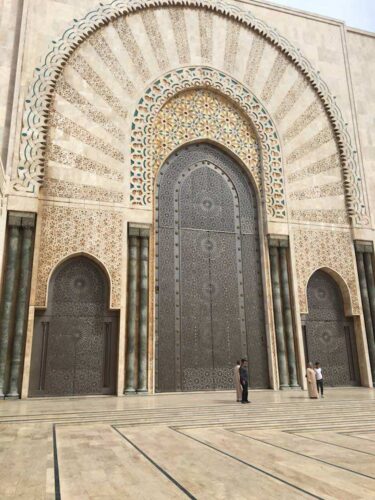
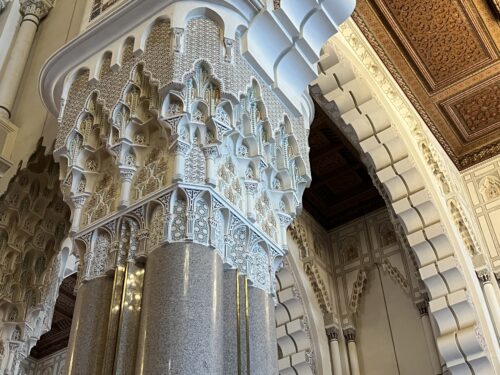
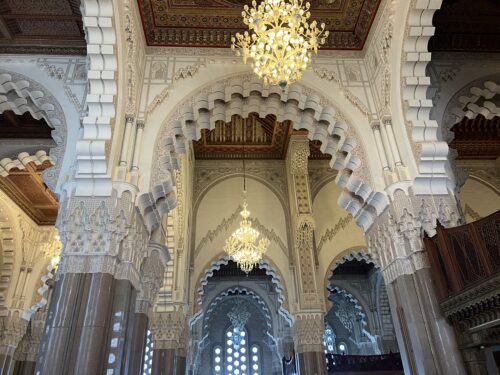
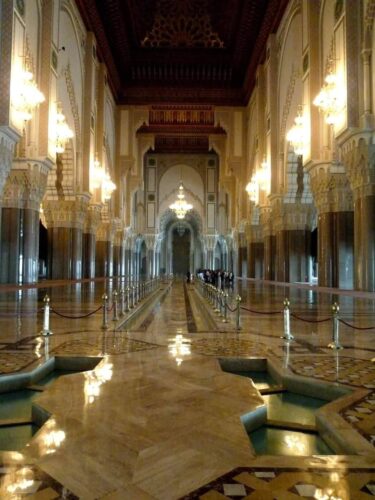
Inside the mosque maintains that old Islamic architectural touch while incorporating modern elements. Though enormous and daunting in size, extremely detailed mosaics, woodworking and stone carvings on a minute level are found throughout the premise. During construction, roughly 6,000 craftsmen and artists worked round the clock to fashion these decorative features. Exemplifying Morocco, the mosque is fashioned out of materials from around the country. This includes marble from Agadir, cedar from the Middle Atlas and granite from Tafraoute. The only imported items are glass from Venice used in the chandeliers and white granite used for the columns.
On our agenda was a visit to Café Ricks! If you’ve seen the classic movie “Casablanca” with Humphrey Bogart, this as the place where he says the famous line “play it again, Sam.” While the movie wasn’t actually shot in Casablanca, they’ve recreated the exact same café here but it sounded very touristy and we were running out of time so decided to explore the suburb of Anfa instead.
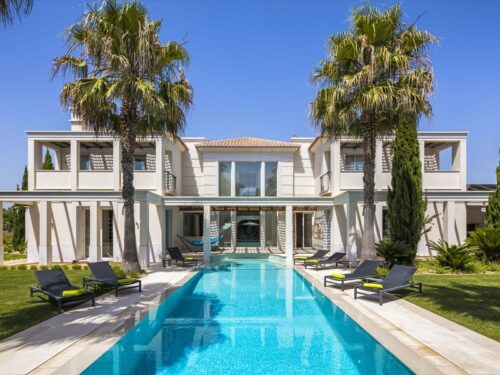
Anfa is one of the more exclusive neighborhoods in Casablanca. Known for its leafy streets and luxurious villas, Anfa captures the essence of modern Moroccan elegance. The area is a blend of the old and new, where traditional Moroccan architecture meets contemporary design, making it a fascinating place to explore.
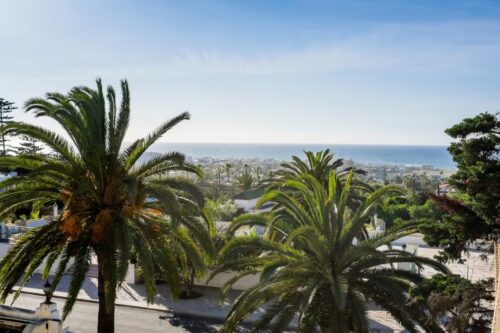
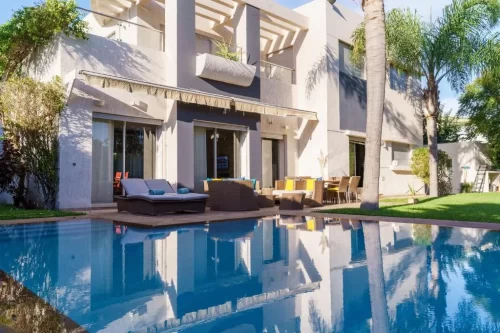
It was in Anfa that the Casablanca Conference was held. The Casablanca Conference was a meeting between U.S. President Franklin D. Roosevelt and British Prime Minister Winston Churchill that took place from January 14–24, 1943. While Soviet Premier Joseph Stalin received an invitation, he was unable to attend because the Red Army was engaged in a major offensive against the German Army at the time. Also attending were the sovereign of Morocco, Sultan Mohammed V and representing the Free French Forces, Charles de Gaulle and Henri Giraud though they played minor roles and were not part of the military planning.
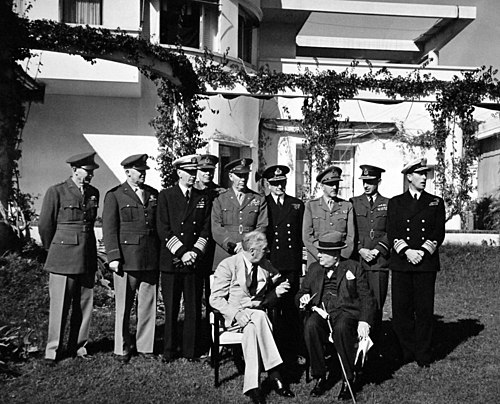
Key decisions included a commitment to demand Axis powers’ unconditional surrender; plans for an invasion of Sicily and Italy before the main invasion of France; an intensified strategic bombing campaign against Germany; and approval of a US Navy plan to advance on Japan through the central Pacific and the Philippines. The last item authorized the island-hopping campaign in the Pacific, which shortened the war.
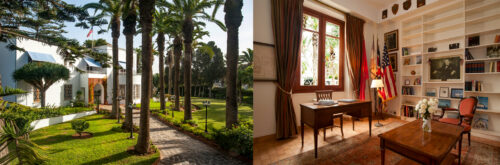
Whilst the original Hotel Anfa where the Conference took place is now an apartment block, many of the luxurious villas they stayed in are still in existence including the Villa Mirador where Churchill stayed, which is now the official residence of the U.S. Consul General in Morocco, The picture on the right is where Churchill set up his traveling “war room” filled with maps of all theatres of war.
No visit to Casablanca is complete without a visit to one of the Souks and we were no different. The Souk we visited was located within the medina, the old walled part of Casablanca and it offered a vast range of products, including spices, leather goods, carpets, pottery, clothing, jewelry, and local crafts.
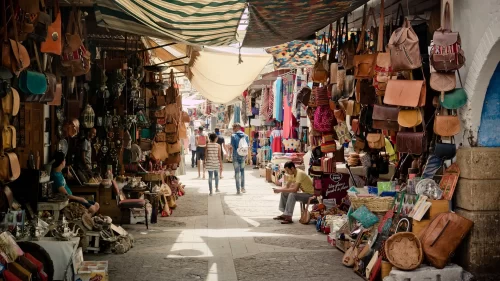
We wound our way through the narrow streets with merchants calling out and offering us all sorts of ‘unbelievably cheap’ deals – robbing themselves for our benefit! We finally stopped at a caftan shop. It was one room wide and about 8 stories high. The cheapest caftans were on the ground floor and as you climbed higher they became more intricate and more expensive. The top floor housed the special occasion caftans, mainly bridal, and with a starting price of over $1000.
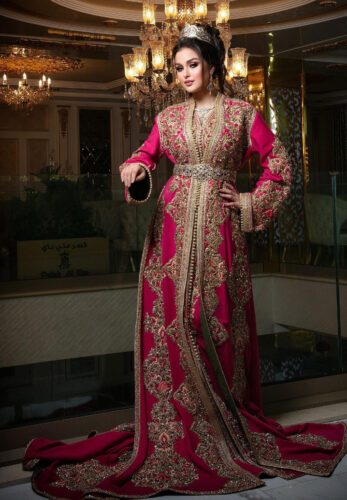
We didn’t make it to the top and settled for a creation of black silk and gold embroidery from the 3rd floor!
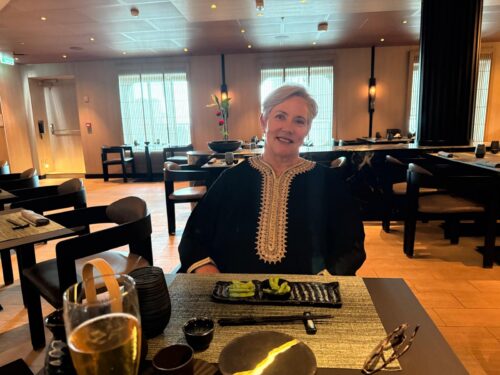
Wearied from the stress of bargaining we returned to our hotel to sort out our packing and travel arrangements for the next day. The following evening we were back in Barcelona staying at a very comfortable Airbnb with an outside terrace, which was excellent for drying what seemed to be copious amounts of laundry.
Finally, with our bags repacked with clean clothes, we were ready to embark on the next part of our adventure.